
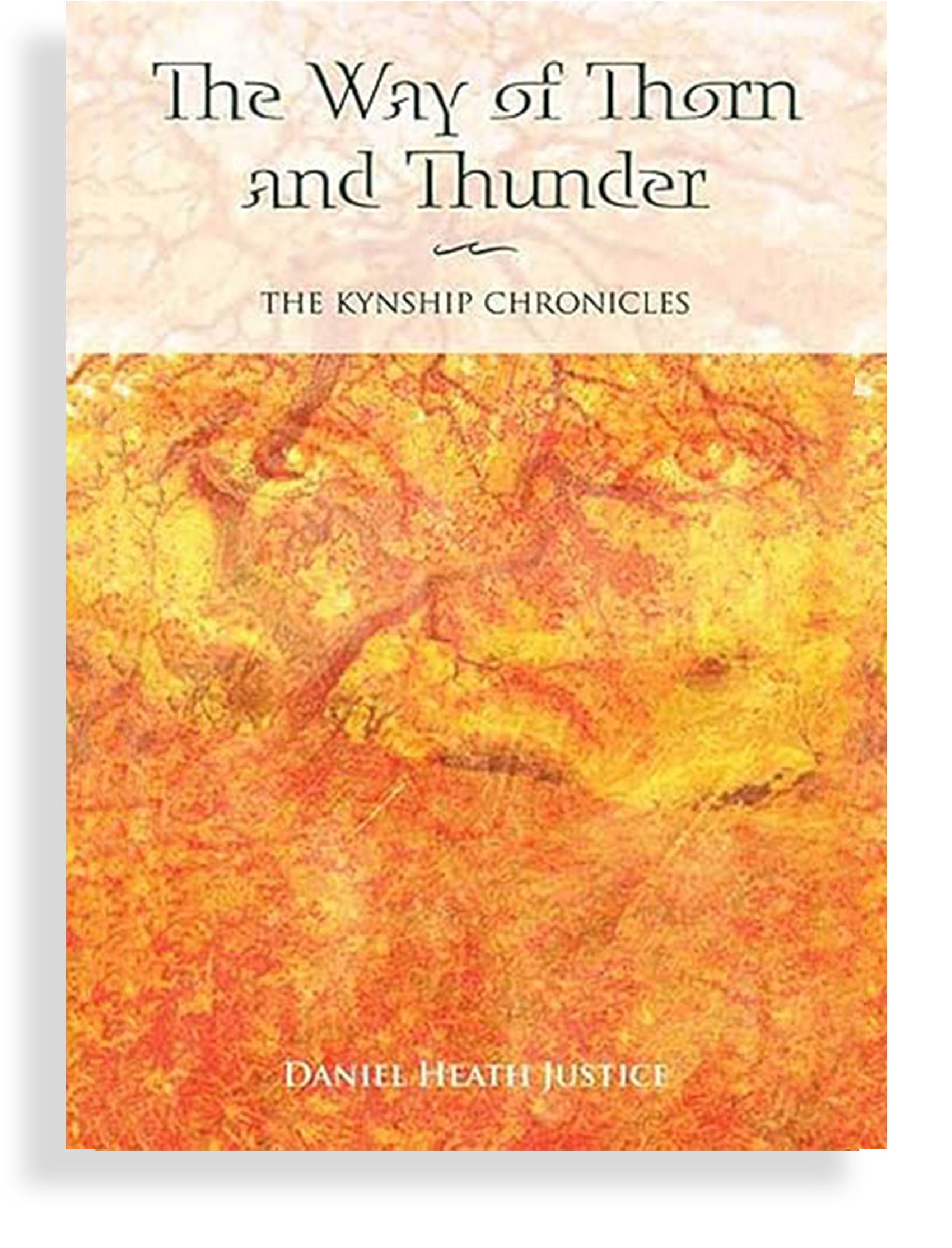
The Way of Thorn and Thunder: The Kynship Chronicles
UNIVERSITY OF NEW MEXICO PRESS (2011)
Taking fantasy literature beyond the stereotypes, Daniel Heath Justice’s acclaimed Thorn and Thunder novels are set in a world resembling eighteenth-century North America. The original trilogy is available for the first time as a fully revised one-volume novel. The story of the struggle for the green world of the Everland, home of the forest-dwelling Kyn, is an adventure tale that bends genre and gender.
Praise
“Daniel Heath Justice’s The Way of Thorn and Thunder: The Kynship Chronicles extends the decolonizing imperative of indigenous studies to the popular genre of fantasy fiction. The expanded omnibus edition from the University of New Mexico Press brings together in a single volume the trilogy originally published by Kegedonce Press as Kynship (2005), Wyrwood (2006), and Dreyd (2007). The sizeable edition, at more than six hundred pages with maps, illustrations, and an extensive glossary, may attract new audiences to Justice’s richly imagined universe of clans, warriors, and sundry nonhuman “Folk” whose homelands are threatened by encroaching human settlers. Justice’s novel plumbs the complex dynamics of colonization and forms of cultural endurance in a changing world. In doing so, The Way of Thorn and Thunder contests simplistic critical categories and expands the imaginative reach of contemporary Indigenous literature.”
—Kathleen Washburn, University of New Mexico
“Justice has created a fantasy epic so rich in history and so complex with all of its inhabitants and mystery that you’re never going to want The Way of Thorn and Thunder to end. What a treasure for anyone looking for heroes and adventure in a series based on Aboriginal philosophy and wisdom.”
—Richard Van Camp, author of The Lesser Blessed
“The Way of Thorn and Thunder is a beautifully wrought high fantasy novel, drawing from the unique and fascinating cultures of North America’s aboriginal peoples but successfully creating a world and characters that stand on their own, and are even set apart from what we usually see in high fantasy. Readers who enjoy meticulously created landscapes and cultures, as well as language that is by turns both visceral and elegant, will likely find much to love in The Way of Thorn and Thunder.”
—Karin Lowachee, author The Gaslight Dogs
“A powerful heroic fantasy, notable for being set, not in the familiar myth-Europe of most such fantasies, but (like Liliana Bodoc’s haunting Saga de los Confines) in the Old World of the Western Hemisphere, the Native American world, where the true, deep roots of magic are threatened by conquest and destruction.“
—Ursula K. Le Guin